Web-Based Remote Monitoring

MedWatch

Post-operative remote monitoring, patient data from home, structured summaries for the clinical team.

A web application running on a local server that collects patient recovery data during home recovery, then surfaces structured summaries and threshold alerts for clinical teams to review between scheduled follow-ups.

MedWatch
Clinical Dashboard
Dashboard
Patients 12
Alerts 3
Analytics
API StatusConnected
Last Update12:45 PM
Real-time patient monitoring system
Total Patients
12
Critical Alerts
3
Stable Patients
7
Patient Monitoring
All Status Expand All
LS
L. Sorrin Day 3
10%
51%
98
bpm
Critical
SP
S. Sarekson Day 22
28%
57%
102
bpm
Critical
RW
R. Windrunner Day 4
35%
73%
84
bpm
Monitor
SG
S. Gamgee Day 5
66%
87%
72
bpm
Stable
LO
L. Organa Day 30
83%
95%
74
bpm
Stable

The Problem

Complications don't wait for follow-up appointments.

After discharge, patients recover at home for days or weeks before their next clinical contact. Complications, surgical site infections, respiratory decline, wound dehiscence, can develop silently in that window with no mechanism for the care team to know.

MedWatch closes the gap by turning the patient's smartphone and wearable into a passive monitoring channel, giving clinicians structured recovery data without requiring EHR integration. In many healthcare settings, the complexity of EHR access, governance requirements, and institutional barriers make direct system integration impractical. MedWatch is designed to operate independently of the EHR, as a lightweight, deployable remote monitoring layer.

Current Care Gap

No visibility post-discharge

Once a patient leaves the hospital, clinicians have no systematic view of how recovery is progressing at home.

Delayed symptom reporting

Patients often wait days before calling a provider, by which point minor complications have escalated.

Unplanned readmissions

Without structured home monitoring, preventable complications drive costly emergency returns and 30-day readmissions.

The Interface

A clinician dashboard built for triage.

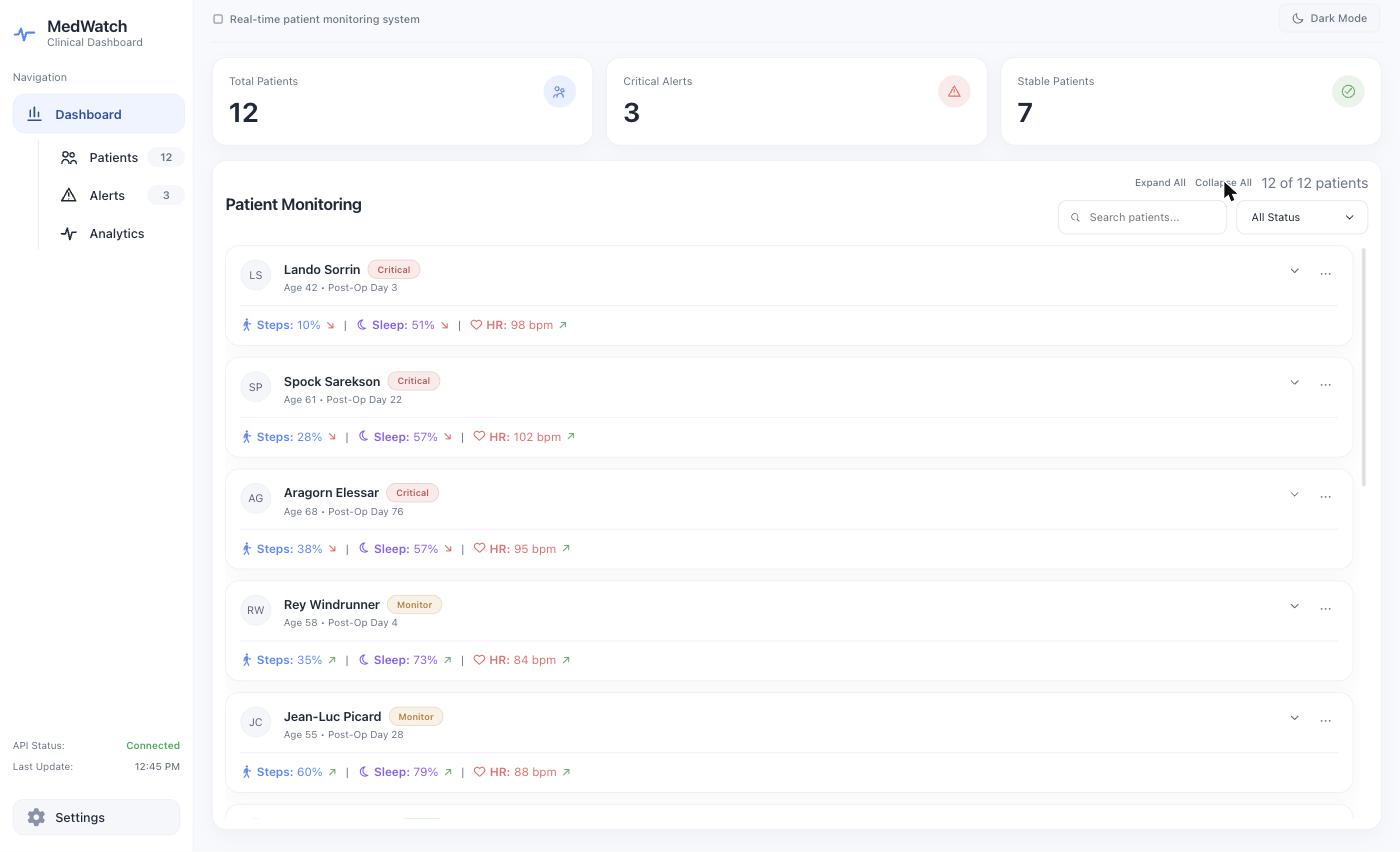
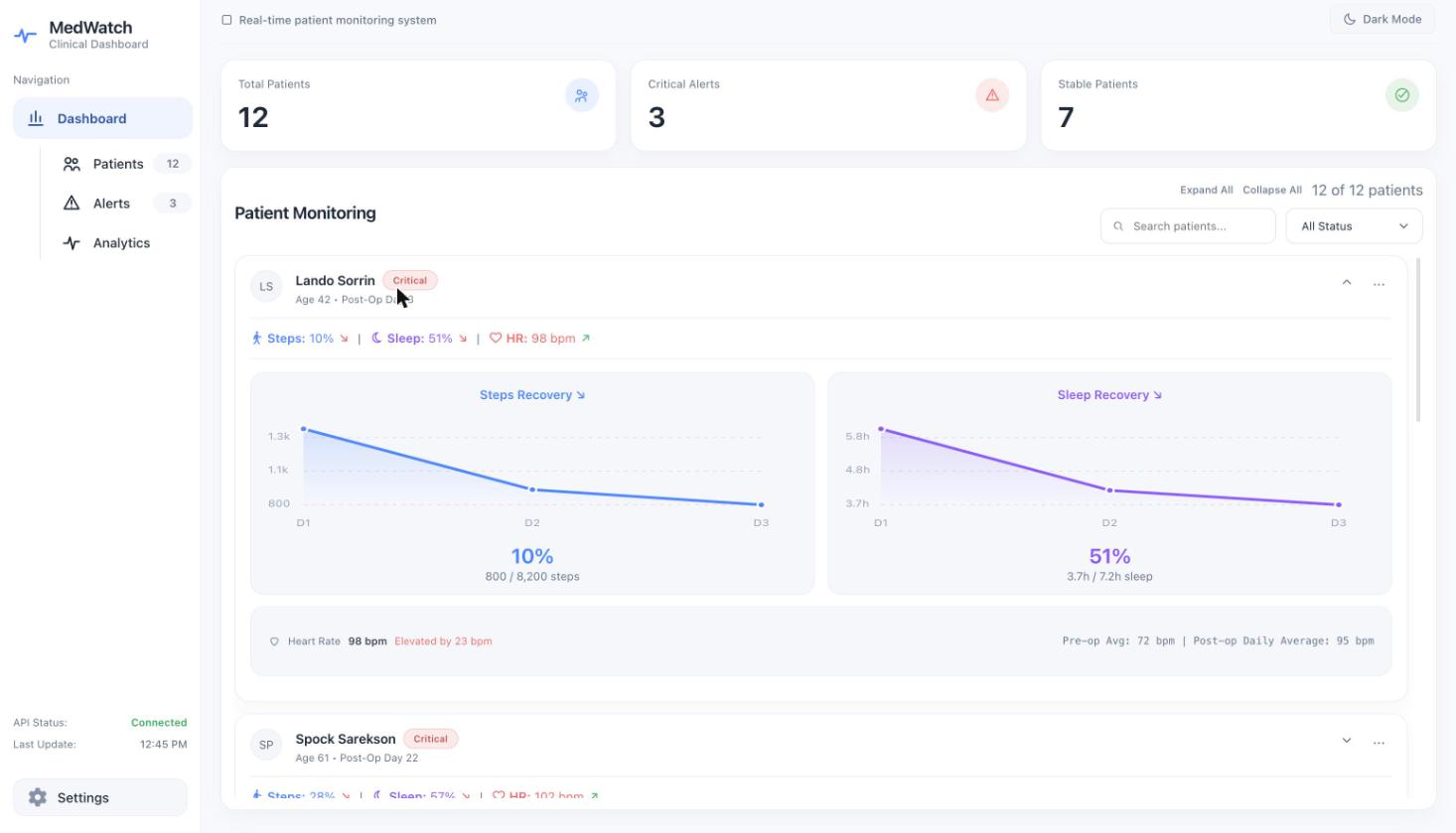
Patient recovery data is presented as a triage-ready list. Status-coded summary cards summarise the cohort at a glance, and each patient row exposes their steps, sleep, and heart rate trend. Expanding a row reveals full recovery charts compared against the patient's own pre-operative baseline.

MedWatch clinical dashboard with all patient rows collapsed, showing the triage overview

Triage view. Twelve patients sorted by status, with steps, sleep, and heart rate trend per row.

MedWatch clinical dashboard with the first patient row expanded, showing steps recovery, sleep recovery, and heart rate detail charts

Patient detail. Expanding a row reveals steps and sleep recovery charts plus heart rate vs pre-op baseline.

How It Works

From home recovery to clinical action.

01

Patient Logs Recovery Data

During home recovery, patients access MedWatch via their smartphone browser and log daily step count, sleep duration, and heart rate, three key physiological indicators of post-operative recovery trajectory.

02

Data Syncs to Local Server

Patient-entered data, step count, sleep hours, heart rate, is submitted through the web interface and stored on a local server, keeping all patient data within the institution's own infrastructure.

03

Server Aggregates & Scores

Wearable trends are aggregated into per-patient recovery scores and statuses. MedWatch operates as a standalone remote monitoring system, designed for situations where direct EHR integration is not feasible due to institutional, technical, or governance barriers.

04

Clinician Reviews & Acts

The clinician dashboard surfaces alerts and recovery summaries. The team can triage remotely, calling the patient, adjusting medications, or scheduling an urgent visit, without waiting for the next appointment.

Patient Monitoring

Every recovering patient, in one prioritised view.

The MedWatch dashboard sorts patients by acuity, critical cases surface at the top so the most at-risk patients are never buried in a list. Each row shows daily step progress, sleep quality, and heart rate against pre-operative baseline at a glance.

Status thresholds (Critical / Monitor / Stable) are computed automatically from wearable data trends. Clinicians can filter by status, search by name, and expand any row to see full recovery charts without leaving the dashboard.

Acuity-sorted Steps · Sleep · HR 12 patients Search & filter
Patient Monitoring
12 patients · updated 2 min ago
3 Critical
All Status ▾
Patient
Steps · Sleep
HR
LS
L. Sorrin Day 3
10%
51%
98
Critical
AG
A. Elessar Day 76
38%
57%
95
Critical
JC
J. Picard Day 28
60%
79%
88
Monitor
LO
L. Organa Day 30
83%
95%
74
Stable
KF
K. Frye Day 93
107%
104%
64
Stable
● 7 stable ● 2 monitor ● 3 critical
Local server · Web app
LS
L. Sorrin
Post-op Day 3 · Critical
Critical
Daily Steps 800 / 9,000 target
D1 D2 D3
Sleep Quality 3.7h / 7.2h target
Heart Rate (current vs pre-op)
98 bpm ↑ +36%
Pre-op avg
72 bpm

Recovery Trends

Recovery trajectory, visible day by day.

The dashboard charts step count, sleep duration, and heart rate over each post-operative day, comparing them against pre-operative baselines and clinical targets. Trajectory is what matters, a patient at 10% of their step target on Day 3 is expected to be low, but one still at 38% on Day 76 warrants a call.

All data is collected passively by Apple Watch and synced via HealthKit, patients never enter numbers manually. The clinician sees a structured, consistent signal rather than self-reported estimates.

Step count vs target Sleep quality HR vs pre-op baseline Structured data capture

Threshold Alerting

Act before a complication escalates.

Each patient has per-metric thresholds, when daily step progress falls critically below target or heart rate diverges significantly from the pre-operative baseline, the system promotes that patient to Critical status and flags them at the top of the dashboard.

Status is computed automatically from the combination of all three metrics. A patient making good step progress but sleeping poorly moves to Monitor. A patient with declining steps, poor sleep, and elevated HR triggers Critical. Clinicians can intervene remotely, calling the patient, adjusting medications, or scheduling an urgent visit, before the 30-day readmission window closes.

Per-metric thresholds Auto status scoring Critical / Monitor / Stable Remote intervention
Active Alerts 3
LS
L. Sorrin · Day 3
⚠ Critical, Steps & HR thresholds breached
Steps
10%
target: 9k
Sleep
51%
target: 7.2h
HR
98
+36% vs pre-op
RW
R. Windrunner · Day 4
Monitor, Steps below threshold (35%)
MONITOR
KF
K. Frye · Day 93
Stable, All metrics on or above target
STABLE

Why It Matters

The recovery period is a blind spot.

Most postoperative complications manifest at home, not in the hospital. Structured remote monitoring creates the visibility needed to intervene early.

Post‑Op

Home Recovery Focus

Web App

Local server

3 Metrics

Steps · Sleep · HR

Live

Local Deployment