CLARK
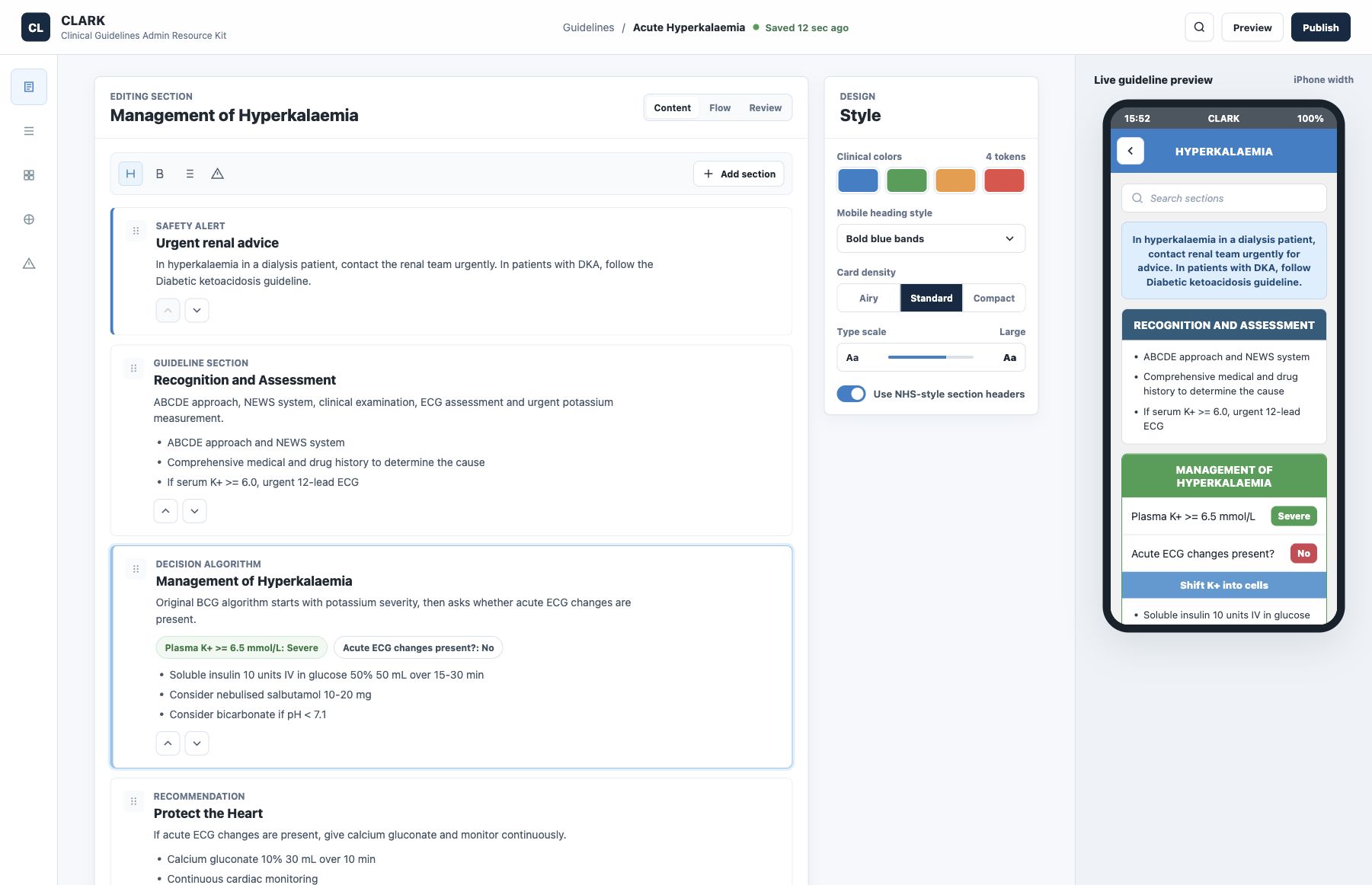
A live authoring environment for clinical guideline apps, designed to help teams edit content, decision pathways, safety alerts, and embedded tools while seeing the mobile experience update in real time.
Overview
Clinical guideline publishing as a live design problem
CLARK, the Clinical Guidelines Admin Resource Kit, was created as an early prototype to explore how clinical guideline content could be authored, structured, and previewed for bedside mobile use. The prototype focused on making guideline editing feel less like static document maintenance and more like designing an interactive clinical product.
The work served as a proof of concept for future clinical guideline authoring systems. Its underlying ideas have since transitioned into ongoing stewardship and further development by UK NHS partners and Keele University, where the emphasis is on sustainable governance, deployment, and real clinical service needs.
Features
A prototype for publishing guidelines as products.
CLARK brought content structure, clinical interaction design, and mobile previewing into one workspace so guideline authors could see the bedside consequence of every editorial decision.
Section Builder
Move the guideline. Change the app.
CLARK treated guideline structure as something authors could directly shape. Recognition, management, monitoring, alerts, recommendations, and tools could be moved as sections, with the mobile layout updating immediately.
Algorithm canvas
Question 1
Plasma K+ >= 6.5 mmol/L?
Question 2
Acute ECG changes?
Recommendation
Shift K+ into cells
Soluble insulin 10 units IV in glucose 50%.
Consider nebulised salbutamol 10-20 mg.
Decision Algorithms
Clinical pathways, not static text.
The prototype represented decision pathways as structured algorithm blocks. Questions, answer states, and recommendations could be authored in a form closer to how clinicians actually encounter them in a mobile bedside workflow.
Live Preview
What authors edit is what clinicians see.
The live phone preview made small-screen consequences visible while editing: reading burden, order of action, warning salience, and whether a section still made sense once compressed into a bedside interface.
Safety alert
Arrange continuous ECG monitoring
Calculator component
Safety and Tools
Warnings and calculators in the same workflow.
CLARK explored how safety-critical alerts and embedded calculator tools could be governed alongside ordinary guideline text. The aim was a single authoring workflow for content, clinical logic, and reusable bedside tools.
Prototype Role
Why it mattered
CLARK helped make a practical research argument: clinical guideline apps need authoring systems that understand structure, interaction, and safety-critical presentation, not just text entry. The prototype offered a way to test that idea quickly with real guideline patterns drawn from bedside clinical workflows.
Its value was in demonstrating the shape of a more sustainable publishing workflow. Rather than remaining a standalone research artifact, the concept has informed continued work led by NHS and Keele partners who are better positioned to align the system with governance, local clinical ownership, and long-term implementation.